Dear Professor,
When I was writing my language and literacy narrative essay, I thought a lot about how language is more than just words, but it’s part of my identity and my history. At first, I wasn’t sure how to tell my story without making it sound too formal and without any “holding water”, but then I realized the audience are people who are going to share something personal as well, and of course you, my instructor. That’s why my language in this essay is more personal with details and feelings so we can see how I really lived through it instead of just giving some facts. One of the main insights I gained during this face is that the reflection helps me connect my past to my present. I didn’t think a lot about my culture before, but while I was working on this essay, it made me feel and recognize how learning Kalmyk was not only about memorizing letters, but also both understanding history, my family, and my belonging to it. I also learned that my writing works best when I start from memory and then link it to bigger ideas like identity.
Some concepts from class that really helped me our audience and purpose. I kept thinking, “What do I want my professor to notice here?” or “What do I want the audience to feel and prioritize the most?”. For example, when I described myself as a shy child feeling like an outsider, it wasn’t just a memory. It was meant to show that theoretical situation of someone struggling with language and identity. I also thought about rhetoric in how I used metaphors like calling language a “treasure” or myself as a “white crow”, to make my writing more engaging and clear about its value. Overall, this assignment showed me that writing is not only about telling a story, but also about discovering myself through the process of working and digging into your oldest memories. I feel like I grew both as a writer, and as someone who understands the deeper meaning of literacy.
Sincerely,
Darina
Secret Treasures of a Language
In a classroom full of excited, hyperactive kids, I sat quietly on an old wooden bench. The day was as shiny as it could be and I remember myself as a shy, non-talkative child who just moved to the new area which was 30 min away from my origin place and I wasn’t willing to talk to others. The teacher came with a loud and irritating bell which meant the start of the class. Somehow, the mix of the sound and the entirety of the teacher made me feel uncomfortable already and I was sure that I would not like to study here. Thankfully, the woman was so nice to us and even asked me if I need any help for this class or if so come to her after class. She brought some books with a picture of a funny looking man and gave it to me, saying “It’s a book that we will learn how to read”. The book was worn, its pages giving off a smell like decaying wood and soggy autumn leaves. It turned out that the guy on the cover of the book was Oirat Lamaist monk, the founder of the language Zaya Pandita. I smiled, because his first and last name literally sounds in Russian like the words bunny and bandit. The words inside the book were crazy due to their vertical way of writing, strange squiggles and I thought I’ll never learn it, even if my mom will disown me. Just a few days after, at the same class, when I came to the room, I felt a bit nervous because the language that I was supposed to know seemed to be so weird and incomprehensible. The situation got worse when I heard how other students and my new friends were discussing an assignment from a teacher when we had to analyze a new poem from the book, and I got stuck there. I saw how my classmates proudly showed how they could boldly read and understand the text in Todo Script. I was so confused—we all shared the same nationality and the same age, yet I felt like an outsider, like a white crow. Will I ever have the same talk like them? I felt like Kalmyk language is not the thing I wanted to study during my childhood. On the other hand, after some time of learning, I started to recognize some patterns in learning and understanding my roots, my history, my family and my surroundings. I started to ask my mom about grandparents, how we got to the point of such a small ethnicity and why we’re located in Russia, but still have our own flag, language and mentality. My mom told me that it’s all about the collapse of the Soviet Union and the War where our descendants were forced to relocate from the origin place, Mongolia. As I dug deeper into my history, I felt as though I was uncovering secret treasures hidden within the language. The letters became more familiar and they no longer felt like my enemies. We started learning how to write simple words, and for the first time, I saw my own name written in Kalmyk. That moment stayed with me because the feeling of writing in a language that looks so different from any other made me feel proud in the way I hadn’t expected. At first, it was scary and confusing, but I realized that once I put real effort into learning, the language begins to give something back, not only knowledge, but also a sense of belonging. Later on, I understood that this language is not just something to study in school but a piece of history, my history, the history of my family, history of my hometown that connects me to my culture. It also carries stories, traditions and even struggles of the people before me like my grandmother who’s been linked to Siberia and came all along to Elista on her own. That’s why I started to see it as a treasure that needs to be protected. If it disappears a part of who I am will disappear with it. Even as a child, I wanted to avoid learning my language. Now I feel responsible to respect it, use it and maybe one day pass it on. It shaped how I see myself and keeping it alive means keeping part of my identity too.
Traslation 1 is one of the major projects I’ve worked on, in which I created a visual presentation of my LLN essay where Im telling about development of language skills. I used my own experience of learning my first language, and obstacles I faced at that time.
For example, in the essay, I mentioned a book that features a man with a funny name, who is actually the founder of an older version of the Kalmyk language, which I studied as my first language.
“She brought some books with a picture of a funny looking man and gave it to me, saying “It’s a book that we will learn how to read”. The book was worn, its pages giving off a smell like decaying wood and soggy autumn leaves. It turned out that the guy on the cover of the book was Oirat Lamaist monk, the founder of the language Zaya Pandita. I smiled, because his first and last name literally sounds in Russian like the words bunny and bandit.”
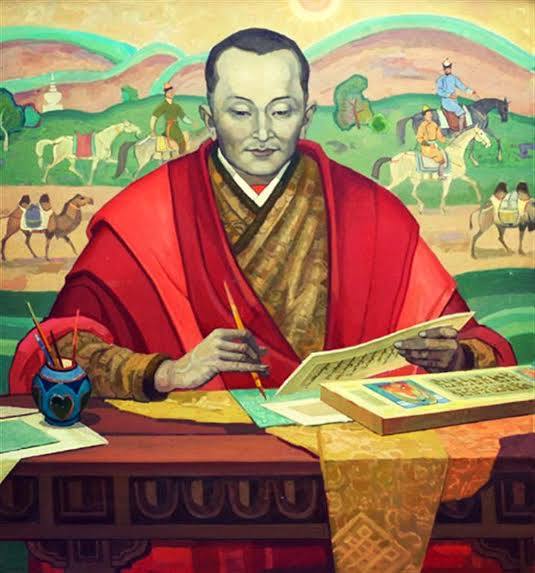
The final product, I turned my essay into a reportage.
This approach allowed me to treat translation as an act of observation and interpretation, similar to how a reporter captures important events. By using a reportage format, I focused on the tone and the cultural meaning carried by the text. This choice of mine reflects my interest in how language shapes experience and how translation can function as a form of storytelling.

This entry is licensed under a Creative Commons Attribution-NonCommercial-ShareAlike 4.0 International license.

